
Transparency Protocol: This transmission may contain affiliate links. If you acquire assets through these channels, the Codex receives a small commission at no extra cost to you. This fuels our operations.
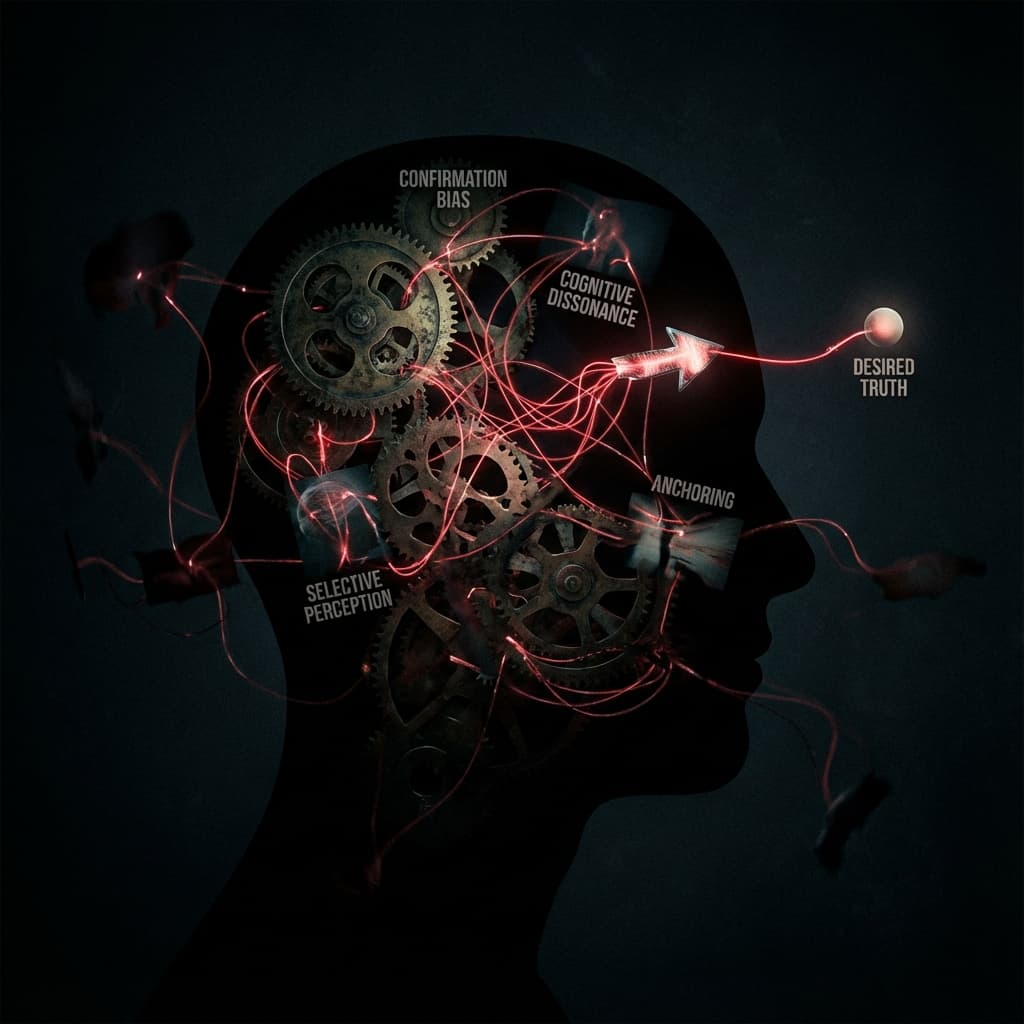
The Hidden Gears of Your Mind
You assume you're rational. You believe your decisions are based on logic, data, and careful consideration. You are wrong.
Beneath the surface of your conscious mind, thousands of invisible gears are turning—systematic patterns of deviation from rationality known as cognitive biases. In the realm of Dark Psychology, understanding these gears isn't just academic; it's a weapon. Marketers, politicians, and social algorithms weaponize these biases to hack your decision-making process.
"The first principle is that you must not fool yourself—and you are the easiest person to fool." — Richard Feynman
1. Confirmation Bias: The Echo Chamber of the Soul
As highlighted in our daily insights, Confirmation Bias is perhaps the most pervasive glitch in human cognition. It is the tendency to search for, interpret, favor, and recall information in a way that confirms one's preexisting beliefs or hypotheses.
How It Works Against You
- The Algorithm Connection: Social media platforms are designed to feed this bias. If you click on one conspiracy theory, the algorithm feeds you ten more. You aren't seeing reality; you're seeing a mirror reflection of your own fears and desires.
- Selective Memory: You mistakenly remember predictions you got right and conveniently forget the ones you got wrong.
Defense Strategy: Actively seek out information that contradicts your worldview. If you can't find a smart person who disagrees with you, you haven't looked hard enough.
2. The Anchoring Effect
When negotiating a salary or buying a car, the first number mentioned sets the "anchor." All subsequent negotiations are adjustments from that anchor, not independent valuations.
- Dark Psychology Application: Stores mark up an item to $100 just to mark it "50% off" to $50. You feel like you saved $50. In reality, you spent $50 on a $20 item.
3. The Availability Heuristic
We judge the likelihood of an event by how easily examples come to mind.
- Fear Mongering: News outlets broadcast plane crashes on loop. You become terrified of flying (statistically safe) but text while driving (statistically deadly) because car crashes cease to be "news."
4. Social Proof and Herd Behavior
When uncertain, we look to others for cues on how to behave. This is why manufactured viral trends work. If "everyone" is doing it, our primitive brain assumes it must be safe and correct.
Conclusion: Reclaiming Your Mind
Cognitive biases aren't "stupidity." They are evolutionary shortcuts that kept our ancestors alive on the savannah. But in the complex digital age, they are vulnerabilities.
To navigate the modern world, you must engage System 2 thinking: slow, deliberate, and analytical. Question your gut. Interrogate your certainty. And always remember: your brain is a machine that can be hacked.


