Transparency Protocol: This transmission may contain affiliate links. If you acquire assets through these channels, the Codex receives a small commission at no extra cost to you. This fuels our operations.
What Are Heuristics and Biases?
Heuristics: Mental Shortcuts
Your brain processes millions of data points every second. It can't analyze everything rationally, so it uses heuristics—mental shortcuts to make fast decisions with limited information.
Why we need them:
- Processing capacity is limited
- Decisions often require speed
- Perfect information is impossible
The problem:
- Shortcuts that usually work sometimes catastrophically fail
- We don't notice we're using them
- Intelligence doesn't protect against them
Biases: Systematic Errors
When heuristics consistently lead us astray, we get cognitive biases—predictable patterns of irrationality.
Key insight from Kahneman & Tversky (1970s): These aren't random mistakes. They're systematic, repeatable errors hardwired into how we think.
The Major Cognitive Biases
1. Availability Heuristic
The bias: Judging likelihood based on how easily examples come to mind.
Example:
- People fear plane crashes more than car accidents
- Plane crashes are memorable and widely reported
- Car accidents kill far more people
- Your brain says: "I can easily imagine plane crashes = must be common"
Where it appears (2024 research):
- Risk assessment
- Medical diagnosis
- Investment decisions
- Fear responses to rare but vivid events
Why it's dangerous:
- Vivid ≠ frequent
- Media coverage distorts perception
- Recent events feel more likely than they are
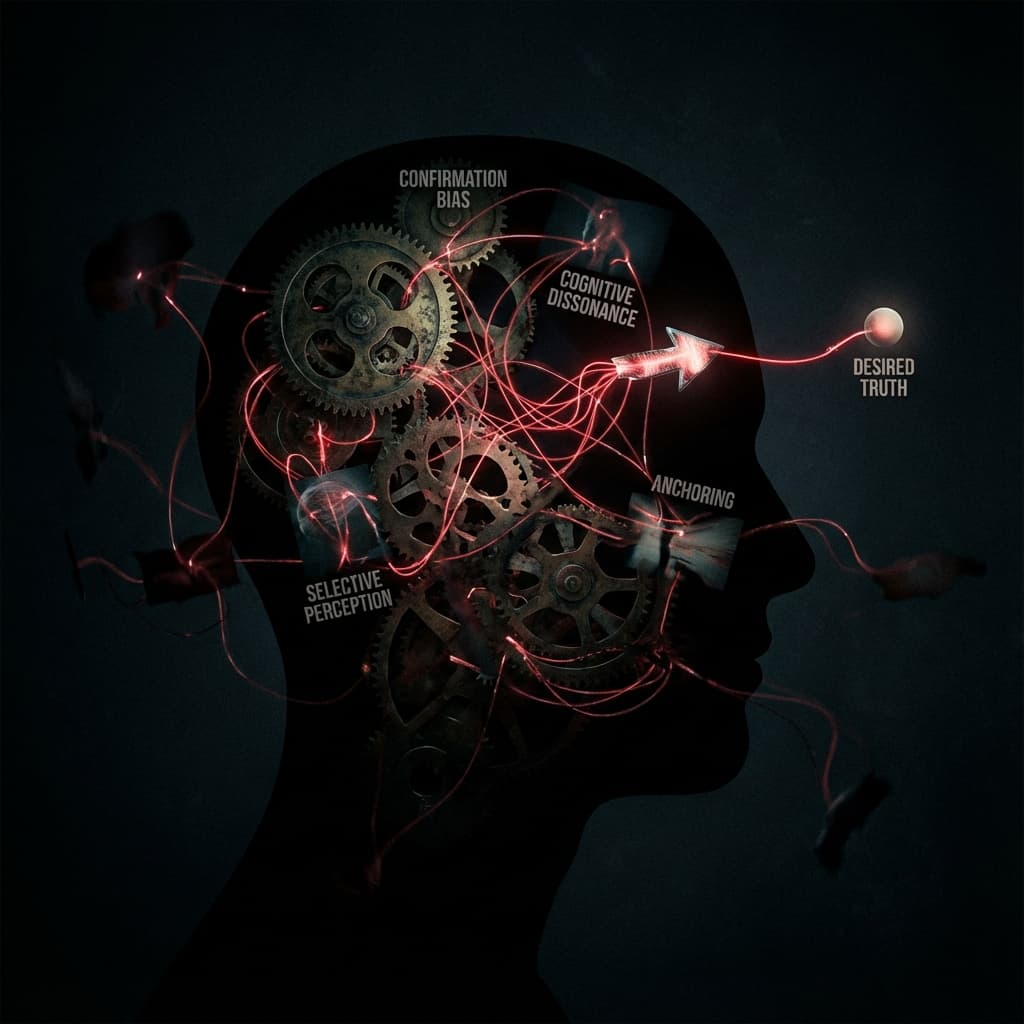
2. Confirmation Bias
The bias: Seeking information that confirms existing beliefs while ignoring contradictory evidence.
Example:
- Believe vaccines are dangerous → only read anti-vax sources
- Believe climate change is fake → dismiss scientific consensus
- Believe your team will win → ignore evidence they won't
How it works:
- We notice evidence supporting our views
- We dismiss evidence contradicting our views
- We interpret ambiguous evidence as supportive
The result: Beliefs become unfalsifiable, immune to evidence.
3. Anchoring and Adjustment
The bias: Relying heavily on the first piece of information encountered (the "anchor") and insufficiently adjusting from it.
Classic experiment:
- Spin a wheel (random): lands on 10 or 65
- Question: What percentage of African nations are in the UN?
- People who saw 10 guessed ~25%
- People who saw 65 guessed ~45%
- The random number influenced their estimate!
Real-world impact:
- Salary negotiations (first offer anchors)
- Real estate pricing (asking price anchors)
- Legal damages (plaintiff's demand anchors)
4. Representativeness Heuristic
The bias: Judging probability based on how much something resembles a stereotype.
Famous example (Linda problem): Linda is 31, single, outspoken, and very bright. She majored in philosophy and was concerned with discrimination and social justice.
Which is more probable:
- A) Linda is a bank teller
- B) Linda is a bank teller and active in the feminist movement
Most people choose B—which is mathematically impossible. B is a subset of A and therefore cannot be more probable.
Why we fall for it: Description matches our "feminist" stereotype, so B "feels" right.
5. Overconfidence Bias
The bias: Systematically overestimating the accuracy of our judgments.
Research findings:
- Experts are just as prone as laypeople
- Appears in medicine, finance, management, law
- Particularly dangerous because it feels like competence
Examples:
- 80% of drivers rate themselves "above average" (mathematically impossible)
- Doctors overconfident in diagnoses (leads to diagnostic errors)
- Investors overestimate their ability to beat the market
6. Planning Fallacy
The bias: Underestimating how long tasks will take.
Why it happens:
- We imagine ideal scenarios
- We ignore past experiences of delays
- We assume this time will be different
Result: Chronic lateness, budget overruns, deadline failures.
7. Outcome Bias
The bias: Judging a decision by its outcome rather than its quality at the time.
Example:
- A doctor makes the right diagnosis with available information
- Patient dies anyway (rare complication)
- Colleagues judge the decision as "bad" because outcome was bad
Why it's flawed: Good decisions can have bad outcomes. Bad decisions can have good outcomes. Judging by results alone is irrational.
8. Status Quo Bias
The bias: Preferring things to stay the same; resisting change even when change is beneficial.
Manifestations:
- Keeping terrible jobs
- Staying in bad relationships
- Maintaining outdated systems
- Default options have outsized influence
Biases in Professional Domains (2024 Research)
Medicine
Common biases:
- Availability: Recent cases influence diagnosis
- ** Anchoring**: Initial diagnosis sticks even with new evidence
- Overconfidence: Failure to reconsider or seek second opinions
Impact: Diagnostic errors, treatment mistakes
Finance
Common biases:
- Overconfidence: Trading too frequently, poor diversification
- Recency bias: Assuming recent trends will continue
- Loss aversion: Holding losing investments too long
Impact: Poor returns, market bubbles
Law
Common biases:
- Confirmation: Seeking evidence of guilt, ignoring exculpatory evidence
- Anchoring: Sentenced influenced by prosecutor's recommendation
- Representativeness: Stereotyping defendants
Impact: Wrongful convictions, unjust sentences
The AI Bias Problem (2024)
LLMs Inherit Human Biases
Recent research using "BiasBuster" framework reveals:
- Large Language Models trained on human data inherit human biases
- AI exhibits confirmation bias, anchoring, representativeness
- High-stakes AI decisions (hiring, loans, sentencing) may embed systematic discrimination
Why this matters:
- We trust AI to be "objective"
- But AI learns from biased human training data
- Result: Automated, scaled bias
Can We Overcome Cognitive Biases?
The Bad News
Intelligence doesn't help.
- PhDs fall victim just like everyone else
- Being aware of biases doesn't prevent them
- Experts in bias still exhibit biases
Why?
- Biases operate below conscious awareness
- They're fast, automatic, effortless
- Rational thinking is slow, effortful, limited
The Good News
Strategies that actually work:
1. Slow down
- Fast decisions use heuristics
- Deliberate analysis engages rational thinking
- Ask: "Am I rushing this?"
2. Consider alternatives
- Actively generate competing hypotheses
- Ask: "What if I'm wrong?"
- Seek disconfirming evidence
3. Use checklists
- Forces systematic consideration
- Prevents anchoring on initial impressions
- Proven effective in medicine, aviation
4. Get outside perspectives
- Others aren't anchored to your initial thoughts
- Fresh eyes spot what you miss
- Diverse viewpoints reduce groupthink
5. Base rates and statistics
- Don't rely on gut feelings for probabilities
- Look at actual data
- Ask: "What does the evidence say?"
6. Pre-commitments
- Decide criteria before evaluating options
- Prevents post-hoc rationalization
- Forces consistency
7. Post-mortems
- Review decisions regardless of outcome
- Separate decision quality from result quality
- Learn from process, not just results
The Uncomfortable Truth
You are not rational. Neither am I. Neither is anyone.
We like to think we:
- Evaluate evidence objectively
- Reach logical conclusions
- Make reasoned decisions
Reality:
- We cherry-pick evidence supporting preexisting beliefs
- We reach emotional conclusions and rationalize them
- We make gut decisions and invent reasons afterward
The brain's job isn't truth—it's survival. And mental shortcuts served that goal well for millennia.
But modern life requires rationality our brains weren't built for.
Bottom Line
Cognitive biases aren't character flaws. They're design features of human cognition—features that malfunction in contexts they didn't evolve for.
The solution isn't to "be more rational" (impossible without external systems). It's to:
- Recognize when you're likely to be biased
- Design systems that counteract bias
- Seek external input and data
- Slow down when stakes are high
- Accept that you'll still be wrong sometimes
Smart people make terrible decisions not despite their intelligence, but because intelligence alone can't override how brains actually work.
The question isn't whether you're biased. It's whether you'll admit it—and build safeguards anyway.
Sources
- Kahneman & Tversky - Foundational heuristics and biases research (1970s-2000s)
- Frontiers in Psychology - "Cognitive Biases in Professional Decision Making" (2024)
- ArXiv - "BiasBuster: LLM Cognitive Biases Framework" (2024)
- Psychological Science - "Social Group Perception Biases" (2024)
- Multiple psychology journals - availability, confirmation, anchoring research
- NIH/PubMed - cognitive bias and decision making
- The Decision Lab, eSoftSkills - bias catalogs and research summaries
- Wikipedia - Comprehensive bias listing and examples
This article synthesizes decades of cognitive psychology research and current 2024 findings on bias in humans and AI systems.